Tap Yes on the Google Prompt to Continue Greyed Out
This forum article is no longer being updated. An updated version of the procedure is provided at If the Admin prompt has a greyed out or missing Yes button ... - TenForums
Technical Level : Basic Summary
If you get an Admin prompt in which the Yes button is greyed out or missing & which does not show a password entry box, your Admin-level account has suffered from user profile corruption and is no longer functional.

Before fixing the problem using the procedures in this article, it is worth documenting the current state of all your user accounts as a reference during this procedure. Full instructions for doing so are provided.
Some potentially quick recovery procedures, such as Restore from a system restore point, might work in your circumstances so this article starts by identifying the most common of them.
If you cannot recover using one of these quick solutions, however, you should be able to boot into Safe mode where the login screen will show a user account that does not normally appear; it has the username Administrator and it exists for precisely this situation - when no functioning user-created Admin accounts exist on the computer.
You can use this Built-In account to create new Admin-level accounts for your own use. Once you have made those new Admin-level accounts you will once again have control over your computer including the ability to give permission for such things as installations. The Administrator account will then be disabled once again by the system and you will not see it in the list of user accounts at login.
This article guides you through booting into Safe mode then creating two new Admin-level user accounts. You can then either make use of one of them as your day-to-day user account or can use them to create an additional account for day-to-day use.
Whilst the procedure seems complex I have endeavoured to describe it in terms that any user can follow. Please don't be put off by trying to understand the entire article; after perhaps skimming through the whole thing once, just read each paragraph, do the step concerned then move on to the next paragraph.
Denis
Details
1 Record the current state of your user accounts as a reference
1.1 Open a command prompt window - Start button, Windows system, Command prompt. Note that you do not need to open this as Admin.
1.2 Enter net user [i.e. type in net user then press the Return/Enter key]

1.3 You will see a list of the accounts that are on the system. You can save the list by running an alternative form of the command such as** the example given below.
net user >"D:\Desktop\NetUser-ListOfUsers.txt"
** There is no significance to my use of my {relocated} Desktop folder as the place to save the file, you can save it anywhere you want. Your Desktop might well be at C:\Users\YourUserName\Desktop so you could use the command
net user >"C:\Users\YourUserName\Desktop\ListOfUsers.txt"
I have included quotation marks, they are only essential if there is a space in the path.
1.4 The list will include the accounts you have created, the accounts created by Windows and you might also see some accounts created by your computer maker {such as my defaultuser0 user account} or your applications. Your own username might not appear to be quite as you expected it [this is explained below] but will match the foldername used in C:\Users\YourUserName.
1.5 You can get further information about each account by adding the name of the account onto the net user command using the version of the username that appears in the initial net user list -
net user Administrator
net user YourUserName
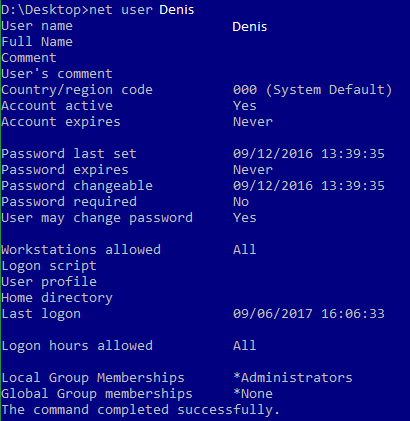
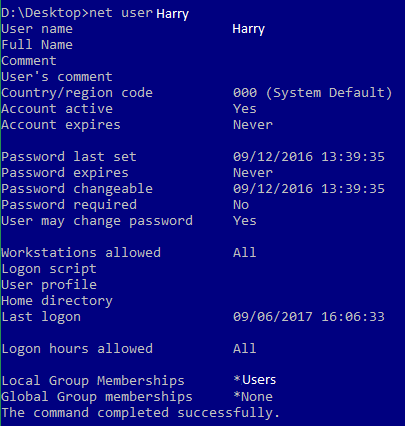
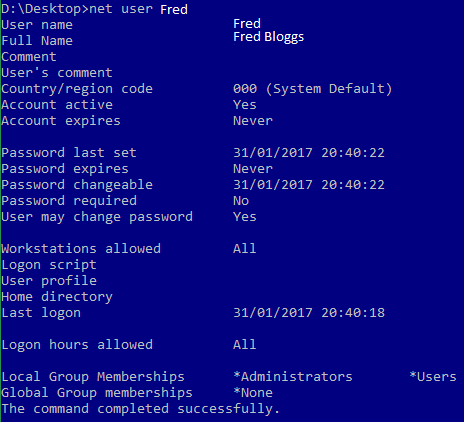
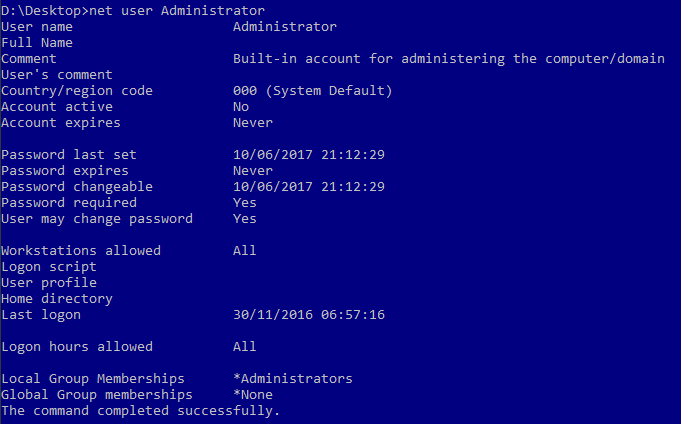
1.6 The results will look like this -
1.6.1 Local user account [Admin] results - It has no Full name entry and is therefore a Local user account. It is a member of the Administrators group i.e. it is an Admin account.
1.6.2 Local user account [Standard user] results - It has no Full name entry and is therefore a Local user account. It is not a member of the Administrators group but is a member of the Users group i.e. it is a Standard user account.
1.6.3 Online-linked user account [Admin] results - It has a Full name entry** and might therefore be an online-linked user account such as an MSAccount [so you can compare this entry to the name shown online in your MSAccount].It is also possible for you to have inserted an entry into the Full name field manually by changing the account's name in Control panel but that is such an unusual procedure that you are likely to remember having done so. It is a member of the Administrators group i.e. it is an Admin account. [** The full username registered for the MSAccount is Fred Bloggs. The username Fred is used in the path C:\Users\Fred.]
1.6.4 Built-In Admin user account results - It has a Comment entry and is an account that has been created by Windows**. It is a member of the Administrators group i.e. it is an Admin account. It is not active - this is normal. [** The existence of a Comment entry probably indicates that it has been created by the computer maker or one of your applications but it is possible for you to set this field yourself.]
2 Do at least consider some potentially quicker recovery procedures instead
2.1 If you already have another Admin-level user account then you can use that to create a new Admin-level user account to replace the defective one. You can also use the guidance in para 5.4 below to rescue the defective account's contents and potentially even repair the defective user account.
2.2 Do not dismiss the notion of simply rebooting. The problem might only be intermittent. If it is intermittent then catch the system while it's working to create two new password-protected Admin-level accounts before the problem returns - see paras 5.2-5.5 below.
2.3 Take a look at Recovery options in Windows 10 - Windows Help You might be able to, for example, take the computer back to a recent stage at which everything was working by using the Restore from a system restore point procedure. This can be useful if the computer made a Restore point before the fault appeared. I cannot advise on any of these recovery procedures because I rely on making frequent system images instead.
2.4 If you already have a recent system image made before the fault appeared then restoring it would be, in my personal opinion, the most appropriate recovery method as long as you have an up-to-date backup of any of your own files that are on the same drive as your Windows installation. There is a guide to restoring system images in this Wiki article.
2.5 This proposed solution[FIX] You've Been Signed In With A Temporary Profile InWindows 10 is derived from an MS KB article [KB947215 article, see para 5.4 below] but specifically addresses the possibility that you are currently using a temporary profile. This would have been reported in a notification at logon so I would expect that to be the main symptom you would have been searching for in this forum rather than the symptom Admin prompt has a greyed out Yes button. I have included the link just in case you have landed on this Wiki article anyway.
2.6 If none of these quicker recovery methods work for you then you will need to use the Safe mode method explained in this Wiki article.
3 Boot into Safe mode
Boot into Safe mode by following this procedure. There is also an illustrated and well-explained procedure in Safe mode that you might prefer but it does not have all the steps and explanations that I have provided.
3.1 Prepare - Do you normally boot up to a logon screen
or have you bypassed that using netplwiz so that you boot up straight to your desktop without having to sign in every time
or {for local accounts only} you boot up straight to your desktop without having to sign in every time because you have never set a password for your day-to-day user account?
3.1.1 If you boot up to a logon screen, it eases getting into Safe mode
3.1.2 If you have bypassed the logon screen then attempt to reset it by entering netplwiz in a command prompt then, in thenetplwiz window, selecting your Admin-level user account and setting the checkbox for Users must enter a username and password to use this computer. If you get an Admin challenge when running netplwiz [which would happen if you had set your UAC protection to its highest level] you will not be able to get around it and will need to take the additional step described in para 3.4 below.
3.1.3 If you have bypassed the logon screen because {for local accounts only} you have never set a password for that account you will need to take the additional step described in para 3.4 below.
3.2 Go to Settings, Update & security, Recovery then click on Advanced start-up - Restart now.
3.3 You'll be taken to a blue menu. Select Troubleshoot, Advanced options, Startup settings, Restart.
3.4 You'll be rebooted to another blue menu. Press the4 key* to selectEnable Safe mode. You will be taken to the Safe mode login screen.
* If you were unable [paras 3.1.2, 3.1.3 above] to turn off the attempt to boot straight into your day-to-day user account with no login screen appearing then, immediately after pressing the4 key, press and hold down the Shift key until the login screen appears. If you are too slow then you will have to reboot normally [i.e. not into Safe mode] then repeat steps 3.2-4. I have tried this Shift key procedure repeatedly on a new Windows 10 computer & on a six year old Windows 10 computer upgraded from Windows 7 and it works every time but I have also tried in on an eleven year old Windows 10 computer that is almost-but-not-quite-fully Windows 10 compatible and cannot get it to work. If I was to lose of all my Admin-level accounts on this particular computer I would therefore have to reinstall Windows 10 or restore it from a recent system image.
3.5 StartingSafe mode in Windows 10 does not look like the Safe mode startup you might have seen in previous Windows versions. There is no long list of drivers & other Windows components whizzing up the screen.
3.6 The Safe mode login screen ought to have entries for your existing user accounts, entries for a couple of accounts created by Windows [DefaultAccount, Guest], possibly an entry for an account created by the computer OEM when setting the computer up before sale [such as defaultuser0] and an entry for an account with the username Administrator. Administrator is the username of the Built-In Administrator account**. If the username Administrator is not shown on the Safe mode login screen then you will probably have no choice but to reinstall Windows 10 because it would mean that, although you know that you have no functioning Admin-level accounts, Windows thinks you do. In this forum, we are not allowed to advise any course of action other than reinstallation in these circumstances.
** In the hope of avoiding too much confusion, I will use the termAdministrator in full whenever I refer to the Built-In Administrator account and I will use the term Admin when referring to any Admin-level user accounts that you create.
3.7 Select the Administrator account and log in by clicking the login button or pressing theEnter/Return key - Administrator has no password so there is nothing to type in.
4 Use the Administrator account to fix the problem
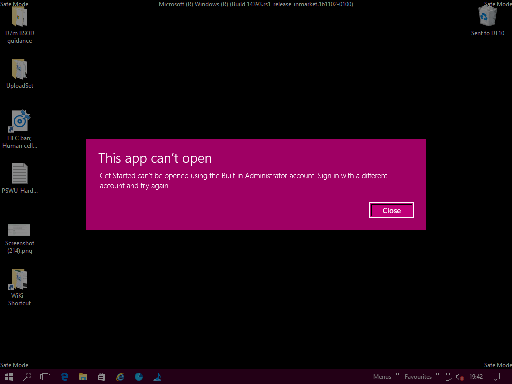
4.1 When you log in to Administrator in Safe mode you'll be taken to a fairly normal-looking, albeit black, desktop. There is Windows version info at the top and the words Safe mode are shown in each corner. You'll get a false warning [that you can simply dismiss out of hand or ignore] that the Get started app cannot be opened or that you'll need to get a new app to open ms-get-started. This false warning** seems to be a bug that Microsoft have not addressed.
** Note that if you ever log in to Safe mode using any other user account, you will get a false warning [that you can simply dismiss out of hand or ignore] that the Tips app or another app cannot be opened "using the Built-In Admin" even though you are not using it.
4.2 Create a new Admin account with a password. You can change the password later so you can just keep it simple for now as long as you do not go online until you have finished. You can call the new user account almost whatever you like as long as no existing account uses the same name so do not call it Administrator, DefaultAccount or Guest and do not use the name of any of your own user accounts. Avoid spaces in the name & password just to keep things simple, only use characters you can type on the keyboard and don't use any symbols in either of them that File explorer would reject if you tried using them in a filename [so, for example, do not use these * : < > / \ | " ?]. I use the usernameNewAdminPrimary with a password 12345 here by way of example.
Open a Command prompt - click on the Start button, scroll down & click on Windows system then select Command prompt.
Enter net user if you need to check the names used for your existing user accounts.
Enter net user /add NewAdminPrimary 12345
Enter net localgroup Administrators NewAdminPrimary /add
4.3 Repeat this to create another account NewAdminReserve so you have both a new Admin-level account to use and a spare one to rescue the situation if NewAdminPrimary is ever afflicted with user profile corruption.
4.4 The user accounts created this way are "local" user accounts. They exist only on this computer. They are not linked to any online accounts such as MSAccounts.
4.5 Log into at least one of the new accounts without rebooting [Start button, user icon] just to give you confidence that all is now well. This takes a while as Windows has to go through its We're just setting things up for you & It's taking a bit longer than usual, but it should be ready soon routines. Then reboot and log in to one of the new accounts.
4.6 Do something that you know generates an Admin challenge so that you can see that the account is working correctly. You could, for example, use File explorer to go to C:\Program files then right-click, hover over New and click on Folder because that always generates the Admin challenge.
5 Tidy up then start using the computer normally once again
5.1 You should now have a fully controllable computer.
5.2 You should change both of the new Admin accounts' passwords to something sensible now if you just used 12345 when you created them. Make sure you write their passwords down somewhere secure yet readily available to you. Just sign into each one then go to
Settings, Accounts, Sign-in options, Password - Change.
5.3 You can use one of the new Admin-level accounts as your day-to-day account or you can create another account for day-to-day use - creating a standard user account for day-to-day use is the more cautious approach. I have an account for day-to-day use in addition to my two Admin accounts. My day-to-day account is also an Admin account but I could downgrade that to a Standard user account if I wanted - MS used to say that day-to-day accounts should always be Standard user accounts but they withdrew that advice during June 2013. Making your day-to-day account a Standard one has the advantage of limiting the extent to which malware can penetrate your computer because, unless it tricks you into giving it Admin permission to go any further, it will be limited to invading those parts of the computer to which your Standard user account has access. Making your day-to-day account a Standard one will also protect you against the alleged malware that can penetrate into Admin-level actions without generating an Admin prompt if the account in use is an Admin-level one - I have heard about such malware but have not been able to reproduce its actions {perhaps a Windows update has plugged that particular vulnerability}
5.4 Your old Admin-level account has been corrupted. When an account has become corrupted then it is probably a write off but
- You can get into its folders at C:\Users\<UserName> to rescue all your own files as well as the account's Windows & application settings using one of your new Admin accounts - see Fix a corrupted user profile [Windows 7 Help].
- You might be able to fix the account's fault using Method 1 of the Windows 7 KB article You receive a "The User Profile Service failed the logon" error message KB947215
- Somebody once claimed to have used Control panel, User accounts, Manage another account to change a faulty Admin account back to being a Standard account then back to being an Admin account again then back to being a Standard account then back to being an Admin account again and then cycled through this half a dozen times ending with it being an Admin account. After all this, the Admin account's fault had disappeared - it was fully functional again. Whilst it sounds quite strange it worked for that user. It is possible that trying this longshot might affect the system's Restore points. Everything that changes in a system's settings increases the amount of work that System restore would have to do and therefore increases the chances of System restore failing. Additionally, every change in a system is assessed by Windows and then restore points that it deems to be obsolete are deleted so this longshot might trigger such a deletion.
5.5 You should now check that Administrator was disabled automatically when Windows detected that the fault condition that enabled it no longer applied.
Start;
scroll down to Windows system & click on it to expand it,
Control panel,
Click on View by in the upper right and selectSmall icons just so you can see everything,
User accounts,
Manage another account [you will get an Admin challenge that you should now be able to deal with in the normal manner],
Your new accounts and your old account[s] should be shown. Administrator should not.
5.6 If Administrator is still shown then open an elevated Command prompt and disable it.
Click on the Start button,
Scroll down & click on Windows system then right-click onCommand prompt,
Hover over More then click on Run as Admin,
Enter net user Administrator /active:no
5.7 It is important to check thatAdministrator has been disabled because it otherwise represents a backdoor into your computer that an online hacker can take advantage of - Administrator has no password and Administrator generates no Admin prompts so a hacker could be doing anything behind your back.
5.8 Reduce the chances of your accounts being afflicted with user profile corruption again by never forcefully powering off the computer unless the thing freezes up completely leaving you with no choice.
- Never turn it off by holding down the power button for several seconds [as opposed to just pressing it for a moment then letting go], and
- Never turn it off by removing its power supply, and
- Never turn it off while Windows update is trying to install updates.
5.9 Work through the net user checks I described in section 1 above once more and save the results as a reference for use if you should ever encounter user account problems in the future.
- - - - - - - - - - - - - - - - - - - - - - - - - -
That's it.
Now that you have a fully functioning computer you can consider taking the precautionary steps described in ZigZag's excellent Wiki article - Safe mode in Win 10.
Denis
Source: https://answers.microsoft.com/en-us/windows/forum/all/if-the-admin-prompt-has-a-greyed-out-or-missing/21053df9-39fb-4395-be3c-7f1797dc145b
0 Response to "Tap Yes on the Google Prompt to Continue Greyed Out"
Post a Comment